Selecting the tool
Are you using a nail clipper to drive a nail into a piece of wood? You could. It would work, but you are going to spend a lot more time getting the desired results than if you were using the correct tool. The correct tool is a hammer. Is that a ballpeen hammer, claw hammer, or sledgehammer? Ok, I think you get the point.
There are two questions when choosing the correct tools for anything. First, what is the correct type of tool (hammer)? Then, is there a specific tool of that type that will get the task done and allow for flexibility? (A claw hammer allows you to pull the nail out when you bend it.) It shouldn’t be overkill either. Do you want to purchase an air nail gun and compressor if you only have one picture-frame nail to drive?
Technology is technology no matter if you are talking about hammers and nails or websites and Customer Relationship Management system (CRM). There are correct types of tools and better tools of that type for your situation.
Understanding the task first
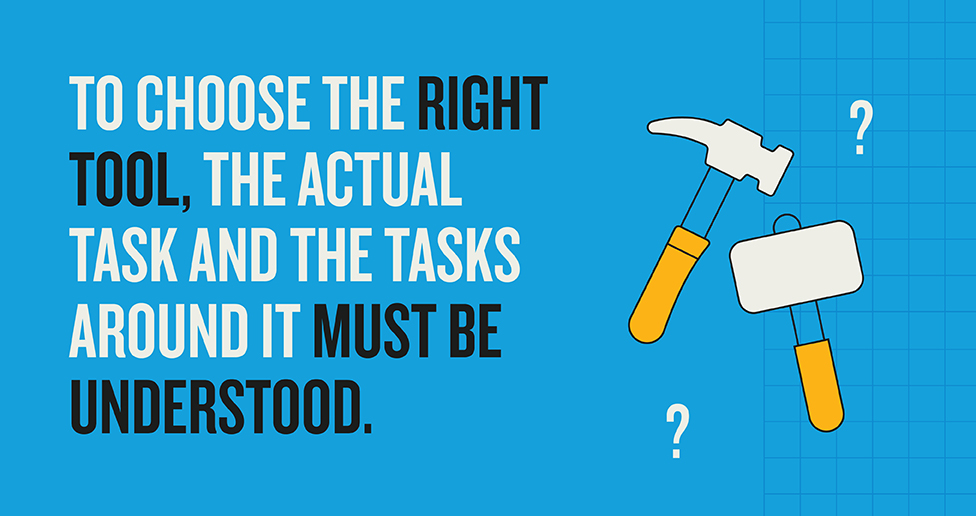
To choose the right tool, the actual task and the tasks around it must be understood. A claw hammer drives nails and pulls bent ones. A sledgehammer is only useful if the person swinging it can handle the weight. The same can be said about your website, CRM, or Enterprise Resource Planning (ERP) for your business. There are so many great choices that work as standalone solutions for each.
What businesses struggle with is thinking about the tasks around those technologies. Can they integrate? If they do, can they integrate directly or are there third-party tools needed? Do they accomplish business logic out of the box, or are there configurations or customizations that are needed? The error is jumping into a technology for that one task without thinking about the entire ecosystem.
Technology should be effective and efficient
The first goal in choosing the correct tool is to make sure the desired outcome can be achieved relatively quickly, accurately, and inexpensively. Back to the hammer, you don’t want to unfold and attach the handle to the head each time you are hammering a nail (relatively quickly). You don’t want the handle to be so wobbly that it is hard to hit the nail on the head (accurately). You probably don’t want the handle to be hand carved from an exotic wood with a gold-plated hammer head (inexpensive).
The technology that you want to choose for your task needs to be implemented quickly with minimal configuration/customization (there is a difference).It should be able to complete the task repeatedly without intervention or corrections, and the implementation cost should not overshadow the gain of the automated task.
Choosing an ERP that is the top rated on all charts has little value for your business if it does not work with your processes. Systems upgrade well when configured within the system, but upgrades often break when customization is performed to fit the business.
Technology should reduce the load, not add to it.
The second goal in choosing the correct tool is to make sure it does not add work or complicate the process for the users. Manufacturing a hammer every time you need a hammer is not helpful. A hammer should be reusable. A carpenter should not need to attach the head to the handle after each hit on the nail. The hammer head is securely attached to the handle so the carpenter can focus on repeated hits to the nail. Better yet, the air nail gun even has multiple nails preloaded so that the carpenter can drive many nails quickly.
All technology works the same way…though Excel is a great tool, if you are required to set up the spreadsheet every time you want to run a report, or if you must update the formulas every time you add columns or rows, then the user is working harder than just entering project data. When you copy/paste email leads into your CRM, you are duplicating efforts and creating chances for errors. Again, each technology on their own does their task, and forward thinking on how all tasks work together is the special sauce that truly helps business.
Technology should be invisible
The third goal in choosing the correct tool is to make sure the user can focus on the work and not the technology. A carpenter does not think about the hammer as they are pounding the nails into the wood; they are thinking about what they are building. A sculptor does not think about the hammer as they break away the stone; they are thinking of the form hidden in the stone.
Don’t ask the technology user to think about the platform they are using, the language behind it, or the safeguards that need to be validated. Allow the user to think about the process. The technology will provide clean and clear flow to the process, validating data up front, and integrating with other systems to prevent double entry.
Where business gets this wrong
Business often gets this wrong by looking only with a microscope at the task in question without looking at what comes before it and what comes after it. How is someone getting the data that is entered into the task? Via email, webform submit, phone. How is the data going to be processed after the task? Is it populating a graph, needed in another platform, being saved for historical uses?
Those pre- and post-time task events are going to help you choose the right tool for the task. Can it be integrated, reduce double entry, validate data values and format, will it use auto updates or batching? Document the complete understanding of the task and the surrounding environment before choosing the tool to prevent disruptions and any rework.
Who should do this?
The question is, who should be doing this work? Most businesses don’t have an in-house technical team. They have teams that lead, sell, produce, ship, and invoice. Experts in each field knowing their business area as they should. Experts in branding, communication, marketing, and technology are needed.
MBB is a full-service digital agency that knows how to understand the desired tasks and outcomes to best develop the branding needed, the communication expected, the marketing required, and the technology applied. Not just the public technologies (websites), but also the back-office technologies (CRM, ERP) along with how the master data flows through the needed integrations to make all the spokes in the business wheel work together.
Most teams don’t need more tools; they need help choosing the right ones and connecting them properly. That’s where we come in.
Subscribe to our newsletter
Get our insights and perspectives delivered to your inbox.