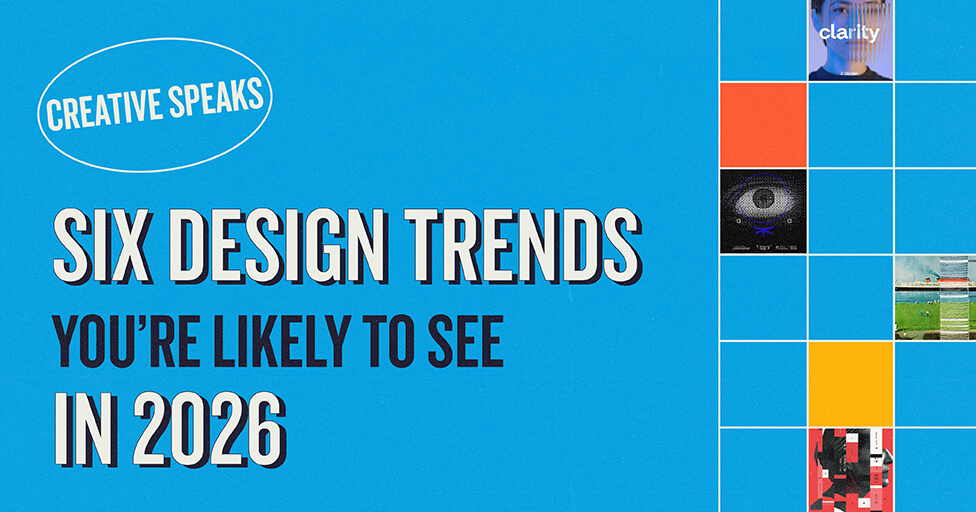
Our creative team took a step back from their daily projects to explore how and why design evolved over the last year—and what that means for 2026. Beyond colors and fonts, they dug into how technology, craft, and culture are evolving—and how those shifts influence the work they create.
The six trends they identified for 2026 reflect a balance between nostalgia for a less–digital world and the expanding dimensionality of an increasingly digital one. Together, they indicate a broader movement toward richer texture, deeper immersion, and more intentional creative expression.
1) A Tactile Touch to Digital Design

As technology continues to evolve in 2026, a refreshing countertrend is emerging: the integration of tactile crafts in the digital space. Inspired by hobbies like needlepointing, sewing, and collaging, this trend allows the texture and dimension of handmade work to breathe new life into the digital canvas—and the designer. The physical activity of stitching, cutting, and assembling allows the brain to slow down, which can be a powerful tool to foster mindfulness and reduce digital fatigue. In the coming year, don’t be surprised to see more textures, layering, and color experimentation that enhance screen-based executions and bridge the gap between material and digital creativity.
2) Liquid Glass

In the fall of 2025, Apple launched IOS 26, which brought a complete visual overhaul to their operating system for the first time in over a decade. This new UI design style is based around the idea of liquid glass. Apple is not alone in adopting this new look—this glass-driven, clear design style has become increasingly prevalent in digital design. It is marked by shadows, highlights, blurs, and the illusion of depth. 2026 will see this visual treatment become even more popular as design shifts slowly away from the flat design that has dominated the past decade toward styles with more depth, texture and detail.
3) Amateur Doodles

Amateur Doodles captures a child-like spirit and leans into a rebellious defiance of typical standards of “good” design. Contrary to the name, this style is not amateur. In order to be implemented successfully, doodle elements need to be carefully considered and balanced with clean typography and gridded layouts with lots of negative space. The idea behind this trend is bringing an authentic, human imperfection into a design landscape that is composed of mostly clean, crisp, corporate identities.
4) Hybrid 2D/3D Motion Design

The rise of hybrid 2D/3D motion design in 2026 comes from a convergence of creative and technological abilities. Brands and audiences crave visuals that feel both dimensional and human, blending the realism of 3D with the clarity and warmth of 2D. New tools now make this fusion seamless, enabling layered, cinematic motion for web, apps, and immersive experiences. The result is a fresh, flexible style that bridges storytelling, interactivity, and brand identity—giving motion designers more expressive, efficient, and emotionally engaging ways to work.
5) Pixels & Dithering

In the early 2020s, we saw an uptick of the use of pixels and dithering in graphic design before falling off. However, the style is making a coming back—again. It’s rooted in the nostalgic aesthetics of the early internet. Think of the 1990s and art tools like MS Paint. This is a natural progression from the Y2K and “desktop core” revivals of 2024 and 2025, continuing the cycle of digital nostalgia. The pixel style will bleed into images, graphics, and even typography. This trend reflects a longing for the days when the internet only lived on the family computer, before it traveled with us everywhere in our pockets.
6) Minimalist Maximalism

Another emerging trend is the rise of maximalist design moments framed within otherwise minimalist layouts—where visual overload is intentionally contained by negative space and strong grid systems. Rather than adhering to rigid principles or filling every inch with detail, Minimalist Maximalism blends the clarity of structure and spaciousness with the richness of layering, vibrant color, and intricate detail. The slight effort required to fully absorb these compositions becomes a feature, not a flaw—drawing viewers in, sustaining their curiosity, and still offering places for the eye to rest. While these ideas aren’t new, the strong minimalist influence of recent years has inspired designers to reintroduce maximalist principles in more controlled, deliberate ways.
Subscribe to our newsletter
Get our insights and perspectives delivered to your inbox.