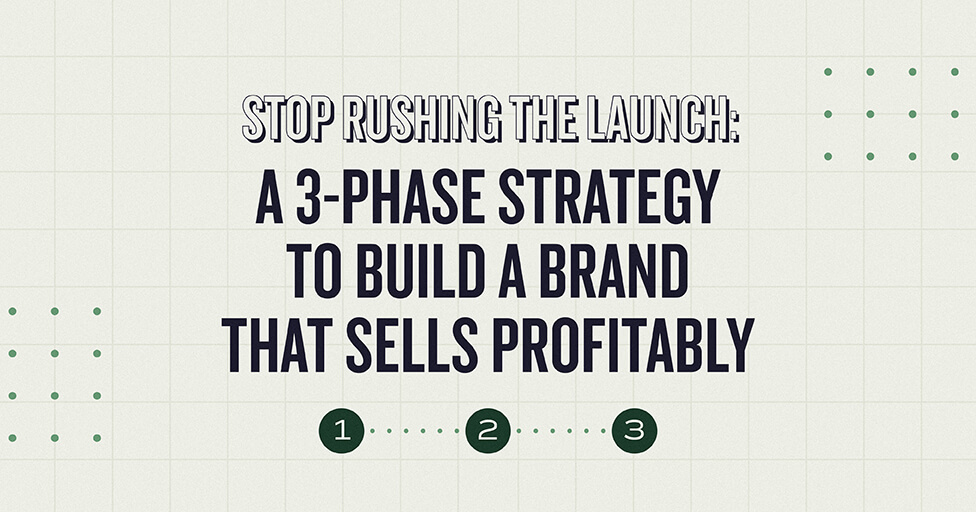
When a product or brand wants to launch, the instinct is often to push out media and expect immediate sales. But if all the reasons consumers choose to buy or not buy from a brand haven’t been considered, you wind up introducing something that isn’t built to sell or scale. The foundational work that makes sales demand possible is frequently rushed or overlooked. There’s pressure to gain traction as soon as possible, but consumers don’t experience brands on business timelines. They move through a sequence of decisions (consciously and unconsciously) that need to be considered and planned for. Without those plans and strategies in place, the sales goals can quickly tank.
Bringing a brand or product to market successfully isn’t about a single launch moment. It’s about guiding people through the psychological steps they need to feel confident choosing you. Over time, we’ve seen this work best when brands think about go-to-market as a three-phase progression centered on underlying consumer needs.
Phase 1: Build Brand Credibility and Trust
Before consumers consider whether your product is right for them, they decide whether you’re credible.
Research consistently shows that trust is a prerequisite for purchase, especially for newer or unfamiliar brands. Consumers use shortcuts to assess credibility quickly—visual design, language, social proof, reviews, third-party validation and clarity of purpose. These signals help them answer a basic question: Is this brand worth engaging with and can I trust them enough to buy?
Whether it’s leadership teams or marketers driving the go-to-market strategy, this phase is often underestimated because it doesn’t always feel like growth. There are no immediate spikes in revenue, and what can seem even harder to swallow is that it requires an upfront investment of both time and money to get right. But skipping it creates issues everywhere else. Campaigns underperform, conversion rates remain low and sales don’t move. What’s misunderstood is why this happens: not because the product lacks appeal, but because consumers haven’t been given enough reason, confidence or context yet.
What we need to do is find ways to establish the credibility and trust they need. That credibility-building work typically includes:
- Clearly defining whom the brand is for and what problem it solves
- Establishing a consistent, confident brand presence
- Demonstrating expertise and category understanding
- Providing proof that others trust the product (through testimonials, reviews or expert voices)
This phase is about forming clarity and legitimacy. Consumers don’t need brands to be big. They need them to feel real, intentional and trustworthy. When credibility is established early, it changes the economics of everything that follows. Media performs better. Messaging resonates. Consumers buy with less hesitation.
Phase 2: Build Brand Awareness and Consideration
Awareness is often considered the first step in a launch. More accurately, it’s actually the second.
Consumer discovery continues to evolve, and people are exposed to brands in environments where context and credibility matter more than brand-led claims. Discovery is increasingly passive at first — a product seen in use, a recommendation surfaced, a brand encountered repeatedly in relevant spaces.
This shift has two important implications.
- Awareness and consideration now happen almost simultaneously. The moment someone becomes aware of a brand is often the same moment they begin evaluating it.
- These early discovery environments reward brands with a clear point of view. While consumers are seeking information around a topic or interest, they’re also absorbing signals that help them place a brand in their lives and assess whether it solves a real need. This is where the work done in Phase 1 starts to matter — when you can clearly answer Who is this for? What does it stand for? Why should I care?
This phase isn’t just about being discovered. It’s about intentionally shaping how discovery happens. To drive awareness and consideration effectively, brands need to show up in attention-holding spaces with consistent narratives that reinforce why the brand or product exists and whom it’s meant for. This can take many forms, but the goal is the same: repeated, contextual exposure that makes the brand feel familiar, relevant and credible.
Many brands struggle here because, without a strong foundation, awareness efforts can actually work against them. Driving exposure for an ill-positioned brand, pushing out inconsistent messaging or sending traffic to a site that lacks proof the product does what it promises from someone beyond the brand doesn’t do you any favors. Instead of accelerating growth, awareness is raised for a brand or product consumers can’t understand and won’t trust.
When done well, Phase 2 builds directly on the trust established earlier. It allows for content and marketing strategies to center on reinforcing credibility through repetition, context and relevance by meeting consumers in their curious moments: when they’re exploring a problem, learning about a category or looking for examples that reflect their own needs. This can take the shape of educational content like FAQs, in-use product stories, third-party perspectives or insider tidbits that solve common problems. Over time, these touchpoints help your target audience get why you’re right for them.
Phase 3: Drive Conversion and Sales
Here’s what we’ve been waiting for and where the focus is all along. In planning, conversion is often treated as the primary measure of launch success, but in reality, it’s a lagging indicator.
By the time a consumer is ready to buy, the work should already be done so they can tick each box for:
- ✅ This is a brand I trust
- ✅ I understand the product
- ✅ I need it to fit my specific need/lifestyle
At this point, the role of marketing is final persuasions and nudges accomplished by removing friction. Brands that rush to this phase too early often rely on short-term tactics to compensate like discounting, desperate messaging or aggressive spends on retargeting unengaged consumers. These can create temporary spikes, but they’re rarely building sustainable, profitable growth. In some cases, they erode the very trust the brand needs to grow.
When conversion is approached as the final step in a thoughtful progression, results shake out differently. Sales come naturally and continue to grow consistently. More meaningful efforts like tweaking media strategies or improving the site’s conversion rate are impactful optimizations that allow profits to continuously improve over time. If you’re relying on short-term sales tactics like one-off promotions or sales to move products, you’re likely bringing in lower-quality customers who aren’t prone to buy again when the sales end. You want more predictable, sustainable growth because it attracts higher-quality customers—people who buy because the product fits their needs, not because a discount made them act. Over time, this means steadier demand, stronger repeat behavior and a business that isn’t getting hit with low margins from marketing.
Yes, This Impacts the Go-to-Market Timeline
One of the hardest adjustments to make is carving out the planning time that a strong launch requires. Often, subjective timelines drive the entry points instead of strategic plans.
This doesn’t mean moving slowly. It means sequencing work intentionally and allowing space for:
- Credibility to be built before awareness is scaled
- Awareness to mature before sales targets are aggressively pushed
It also means coming to market at the right time. Choosing to soft launch if you need or entering a market ahead of the demand curve.
When timelines are aligned with consumer behavior, expectations become more realistic. Teams make better decisions. Budgets are spent more efficiently. And brands are set up for growth that lasts beyond the initial launch window.
The Case for More Brand Strategy
None of these phases can work in isolation. And none of them works without a clear understanding of the customer. At the center of an effective go-to-market strategy is clarity around whom you’re for, what need you serve and how you gain trust and loyalty.
Before setting sales targets or mapping media spend, it’s worth asking whether the foundation is truly in place. Because the most overlooked step in bringing a brand to market is often the one that makes everything else possible.
Subscribe to our newsletter
Get our insights and perspectives delivered to your inbox.